Categories
Argentina Buenos Aires South America

Horse Riding

We spent a few days in Rosario before heading on to a little town called San Antonio de Areco, just an hour out of BA. Sal wanted to go horse riding, and so it seemed foolish not to stop in gaucho country to give it a go. As we had an apartment booked for BA, we decided to blow out on a nice hotel and jumped on the bus.

Unfortunately, when we arrived in tiny San Antonio, it seemed like it wasn’t going to be as easy as we’d thought to get up on a horse of some kind.

“Oh no, you’re too late,” said the man at our hotel, looking at his watch, when we asked about the possibility of horse riding in the morning. “The farm will be closed now. Maybe we can call them tomorrow. But I don’t think so.”

Oh. So off we went to the tourist information office in town.

As my Spanish vocabulary doesn’t quite cover horses and horse riding, and as we were in a tourist information office, my opening gambit to the lady behind the desk was “¿habla usted ingles?” but her reply was just a curt “no”.

So I stumbled through in Spanish trying to explain what we wanted to do. But no, she said, there was no horse riding to be had here. Maybe we could call these ranches out of town. By this point she had switched into the English she didn’t speak, and she went on to tell us that you couldn’t really go horse riding because it’s too dangerous. And the insurance costs too much.

Oh. So off we went away from the world’s least helpful tourist information office. We knew from our hotel search that there was at least one ranch in town (curiously not one of the ones she’d told us to call) so we walked over there.

And there we met a friendly chap called Juan Manual, who laughed at our story and told us that horse riding would be no problem at all, that there’s no such thing as needing insurance in Argentina, and that the reason that the lady at the tourist office hadn’t told us about them was probably because he’d recently interviewed her for a job at the ranch that she’d not been given…

And so off we went the next day.

It turned out to be surprisingly good fun, although after four hours in the saddle, I realised when I got down that there’s a reason why John Wayne walks like that…

Horseriding, San Antonio de Areco

Categories
Uncategorized

Taxi!

There was a time–let’s call it 8.20pm–when, still standing outside our hotel in the centre of Mendoza vainly waving at every full taxi that passed us, we started to think that maybe we weren’t going to be catching our 8.30 overnight bus to Rosario on the other side of the country.

Gone, by this point, were the days when we used to turn up at the bus station an hour or so before departure. We’d learnt that there was really no point in being early and had started cutting things increasingly fine but we’d always been able to jump straight into a taxi and we hadn’t missed a bus.

Yet.

Which was going to be annoying, as we’d paid a whopping A$190 each (about thirty quid) to travel in a sleeper. Argentine buses come in a variety of flavours, with the cheapest, semi cama, being like coaches back in the UK. Next up from that is the cama, which although it literally means “bed” really just means a slightly bigger seat that reclines a bit further. The best, though are the cama suite buses, where the seat goes completely flat and they serve you wine and hot food. It’s well worth the extra pesos if you’re travelling overnight, but not such good value if you miss it.

At 8.25 an empty taxi passed, and responded to my frantic waving by slowing down.

As we threw the bags into the back seats, I jumped into the front and started explaining in my still broken Spanish how we were running a bit late for our bus.

Of course every red light was against us. As we pulled up to one the driver asked us what time our bus left.

“Er, now?” I replied.

And upon hearing the name of the bus company, CATA, he shook his head and declared that he thought we might be out of luck. That company is “muy o’clock” he said, pointing at his watch.

But he let us out anyway around the back of the station (even though by this point it was already 8.35 and we’d almost given up hope) and we legged it with our packs past 25 other platforms, only to see a CATA bus pulling out of the bus station and heading into the distance.

“¿Ha salido el autobus para Rosario?” I asked a bloke wearing a CATA uniform who just sort of shrugged at me in response.

And then I realised that I was standing next to it. Somehow it was still here (and apparently it was just as well I hadn’t run after the other bus shouting “Stop!”). As Sal arrived behind me, we threw the packs into the hold and collapsed into our very comfortable seats. Totally out of breath and quite unable to believe that we’d made it.

And then the bus sat there for another 20 minutes before it left.

*

Our luck began to run out when we got to Rosario, though. As I opened my wallet to pay for the taxi into the centre of town, I realised that the 10 peso note I thought I had in my wallet was actually a 2. Apparently in my panic the previous night I had given either the taxi driver or the guy who puts your bags in the hold of the bus a huge unintended tip.

The only other note in my wallet was a 50, which of course the taxi driver couldn’t change. He turned out to be the world’s most understanding taxi driver, though, as he said he’d just take whatever I had–the 2 peso note and a handful of change. When I asked him if he was sure, he said “it’s only five pesos…”

It was probably just as well I hadn’t gone off to try to change the 50, though, because when we did try to spend it on breakfast a few hours later it turned out to be our first fake note of the trip so far.

“Es falso”, said the girl in the café, laughing and pointing at it. “Muy falso”.

On further inspection, this turned out to be true. It had been amateurishly cut to the wrong size, looked and felt fake, and the foil strip had been drawn on in felt tip.

Oops.

Categories
Argentina South America

Thoughts on Argentina…

* Gosh. They don’t half like a protest here. You can barely move without coming across a group of people airing their grievances. For the first part of our stay in the country there was a big ongoing protest by the country’s farmers against new export duties that president Cristina Fernández de Kirchner was trying to push through. Every time we turned on the telly there’d be the same footage on each of the five local channels, which would either by CFK giving a passionate speech or the senate in the middle of a heated debated about the new taxes. (The farmers got what they wanted in the end, but only after the vice president used his casting vote to break a tie and vote against the bill–clearly someone had an eye on his political future there…)

We’ve come across many protests when we’ve been out and about too. At one point we were in a taxi to the bus station and had to take a detour around a group of hospital workers who were burning tyres in the middle of the road in a bid for better terms and conditions. Then when we got to the bus station the TV in the waiting room was showing a full scale riot taking place in the centre of Córdoba, a town we’d been to a week or so earlier. Of course all the locals around us were just going about their business without paying any attention to the devastation being wrought on their second city. To us this stuff is incredible. To the locals, it’s just what people do here.

* They say that the British like a bit of a queue, but they’ve got nothing on the Argentines. As tourists we have been largely immune to it, but for the locals there is seemingly no part of going about your everyday business that doesn’t involve joining the back of a rather lengthy line.

The closest we came to getting involved in this was when we made the mistake of buying a local SIM card for our phone. In the UK this would have been a straightforward procedure:

(1) Buy SIM card
(2) Place in phone
(3) Make calls

But nothing in Argentina is that simple. It was more like:

(1) Buy SIM card
(2) Realise SIM card doesn’t work
(3) Buy second SIM card
(4) Realise that although second SIM card does work, international calls are barred by default on pre-paid lines
(5) Spend the next few weeks with a local mobile phone that doesn’t do the only thing you wanted it to do
(6) Phone customer service and try to talk to bloke in Spanish until he hangs up you
(7) Finally decide to brave the customer service centre
(8) Join queue stretching almost out of the door just to get a number to wait in line to be seen by one of the customer service representatives
(9) Stumble through a conversation in Spanish with helpful but ultimately clueless person who tells you it is probably the phone but who eventually agrees to raise a help ticket anyway and says that it might be sorted in two days
(10) Finally manage to dial an overseas number on the phone
(11) Realise that credit was loaded onto the phone so long ago that you now only have 2 days to use it before it expires…

* Argentine Spanish is weird. I’m getting better now, but when I first got to Argentina I suddenly found I couldn’t understand anyone (and they couldn’t understand me). It’s bad enough that the Spanish I learnt at school was European Spanish, but speaking Argentine Spanish isn’t just a matter of remembering to “s” every time I was taught to “th”. They have different words for stuff, and (in the area around Buenos Aires) even an entirely different verb form, vos, which replaces tu as the informal “you”. Oh, and the Argentines also pronounce the double l, which is usually a “y” sound, as a “j”. I’m still getting used to saying “pojo”, “boteja” and the like when my instincts tell me it’s wrong…

Ironically, they call Spanish “castellano” here, even though Castilian Spanish is precisely what they don’t speak. The other day someone asked me if I spoke Spanish by saying ¿Caste-j-ano? I think by failing to answer and only pulling a confused expression, I sort of answered the question…

[One thing I do love about Argentine Spanish, though, is their habit of using -ita. You can add this to a Spanish noun to make it a smaller version of the thing (hence senorita is a small senora), and the Argentines have really taken this verbal tick to heart: from preguntitas (little questions) to problemitas, it still makes me smile every time I hear it…]

Categories
Argentina Chile South America

Chile and Argentina…

As nice as it was to be back in civilization, in a land with paved roads and road signs and everything, we didn’t exactly hang around in Chile. In fact, less than 24 hours after we’d entered the country we were back at the same border post being stamped out by the same guy who stamped us in the day before. He didn’t even bat an eyelid as he removed the tourist card on which I’d written that we’d be staying in the country for a month and passed my passport back to me.

It’s not that we didn’t like San Pedro de Atacama. On the contrary, it’s a pleasant little town–if a little touristy–of whitewashed houses and traffic-free streets. And after spending so long at chilly altitude it was lovely to be somewhere warm again (even if it had been cold, there would have been no danger of us shivering through the night, as the bed in our hostel had sheets made of polo fleece–it was as if we’d slept in a big comfy jumper).

But Chile is expensive. With no functioning ATM in town (seriously, what is it with border towns?) and only a limited supply of US dollars to exchange at punitive exchange rates, we were forced to keep moving. And as the bus across the Andes to Salta in Argentina only runs on certain days of the week, the first thing we did after checking into a hotel was to go and buy our tickets out for the next day.

We were joined in Salta by Chris and Kyria, who we’d first met on the chilly salar de uyuni, and who happened to be heading the same way as us. After we’d helped them celebrate American Independence day in Salta they went back to Bolivia and we started to work our way south through Argentina: a day in Tucumán (the cradle of Argentine independence) here, a few in uni town Córdoba there, and several more in Mendoza enjoying the delights of the country’s wine region.

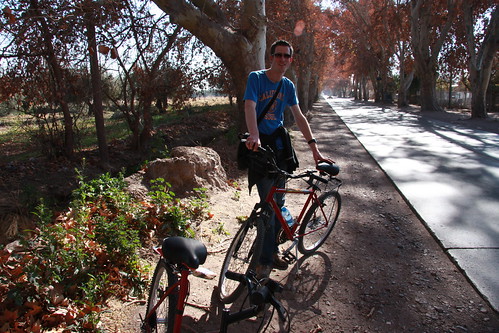
Biking the Wineries of Maipú

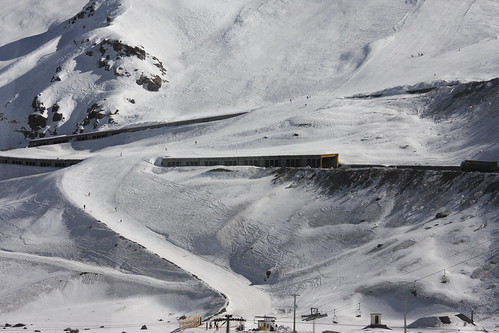
From Mendoza, we poped back into Chile for a little while. The road over there takes you right up to the top of the snowcappped Andes, and back down through the ski resorts on the other side (at one point the road even goes under the ski run–and I hope no one ever strays too far from the middle, as that looks like a rather large drop on either side…)

Chilean Ski Resort

But once again we didn’t hang around in Chile. We spent a few days in Valparaíso, a pretty town on the side of a hill by the ocean where we saw the first rain of our trip so far, and then a few in Santiago, before heading back across the mountains once again to Mendoza.

Categories
Bolivia Chile South America

Salt

There was no electricidad again.

This time we were in the tiny dusty nothing town of Uyuni, ready to set off on our 4WD tour of the amazing Bolivian salt flats. We’d left La Paz the day before on the bus, travelling to a forgettable town called Oruro up on the top deck at the front. Our seats were panoramico, apparently, according to the woman who sold me the tickets. And we certainly had a full and unobstructed view of just how crazy the drivers are in these parts, including our own driver of course–if I’ve got a full panoramico view of the road ahead and I can’t see around that blind corner up ahead, then I’m pretty sure he shouldn’t be overtaking. That was enough Bolivian buses for us, so in Oruro we jumped on one of the few remaining passenger trains in these parts, the Expresso del Sur, which wound its way down the country through some impressive scenery to deposit us later that night in a chilly Uyuni.

27th June 2008: View from the Train

This time a lack of electricidad didn’t mean that we had no water, just that the water was exclusively cold. Our shower, like most Bolivian showers we encountered, heated the water through an electric element in the shower head. But Uyuni was cold. So having no hot water was effectively the same as having no water at all.

As an indication of just how cold it was in Uyuni, we’d been woken from our sleep by the pleasant morning call of the lesser spotter backpacker, as one of our fellow hotel guests was being violently sick into one of the communal sinks in the courtyard just outside our room (these would be the sinks described by the Lonely Planet in its review of the hotel as being “great for laundry”). I wouldn’t have been volunteering to do any of my laundry in them that day, though, as when we left the hotel to find some breakfast we could see that his sick had frozen solid in the bottom of the sink into a sort of piece of abstract art. (And when we came back later to pick up our bags, the poor ladies from the hotel were pouring boiling water over it from a kettle and poking it with a stick to try to dislodge it. Rather them than me…)

*

The salt flats are every bit as stunning as we expected them to be, and there’s not much I can add that the photos don’t already show.

Salar de Uyuni

With such stunning scenery, it’s almost impossible to take a bad photo there. And it also seems to bring out the urge in everyone to mess around with trick photography–we went flying, as we’d seen someone else’s version of that shot back in Cusco, but other groups were taking it to another level. There were people there with props, playing with perspective to shoot themselves climbing into giant Pringles packets, pushing over giant footballs, standing on each others hands, and doing stuff like this.

After we’d spent the day hanging around on the salt, and visiting the spectacular cactus-filled island, Isla Incahuasi, we left the salar to spend the night in a hotel made of salt, in a small town called San Juan.

[I should point out that the salt hotel we stayed in wasn’t the salt hotel. There used to be at least two of these on the salar itself, but they’ve been closed down for environmental reasons. As the Lonely Planet colourfully puts it, they didn’t properly manage the waste, “essentially channelling it back into the same salty crust that you’ve come to admire…” We stopped at one of these hotels while we were on salar and saw that it has been renamed “a museum” (albeit a museum that sells drinks and has beds you can sleep in…)]

*

The second day of the tour took us to some more spectacular landscapes, but we were lucky to have got out to see it at all, as our morning had begun with the not so reassuring sound of a cold jeep refusing to start. It was eventually talked into cooperating (after a small nudge from the tour group), and apart from us subsequently pulling up in the middle of nowhere to let it cool down (“un pocito problema” according to the driver, who then jumped out and started throwing bottled water at the tyres) we made it through the rest of the trip, visiting funny shaped rocks, flamingos, and lagoons along the way.

*

The final night of our salt tour was not only the coldest of our trip so far, but also a timely reminder of why we haven’t been staying in dorms. As we slept in our sleeping bags, under the covers, and wearing all our clothes, listening to the cacophony of snores, grunts and moans coming at us in stereo from the other people on our tour in the dorm beds around us, we vowed to stick to the private rooms again from now on.

We also vowed that perhaps we should head for somewhere at a slightly lower altitude that might be a bit warmer, but as luck would have it, the start of the third day of the tour passed within spitting distance of the Chilean border, and so rather than head all the way back to Uyuni (which only offered more Bolivian buses, more freezing altitude, and no doubt more electricity-free hotels), we opted to jump off the trip and cross over to San Pedro de Atacama, a tiny tourist town just over the other side of the border down in Chile.

In fact, we’d technically left Bolivia two days earlier, when we’d got our exit stamps in our passports in Uyuni before the tour, although we wouldn’t enter Chile until we’d not only left the tour at the Bolivian border but also travelled a further 40 or so kilometres down to San Pedro. This confuses the hell out of me, by the way: where were we between stamping out of Bolivia and entering Chile, for starters. But then as someone who spent his formative years living on an island, I always find land borders a bit weird…

Bolivian Border...

Categories
Bolivia South America

The 1980s

Discover Bolivia Magazine...

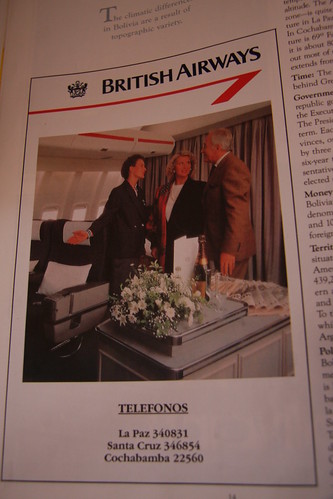
In our room at the hostel in La Paz was an ancient tourist information book, called Discover Bolivia, or something like that. It claimed to have been published in 1991, but it also included helpful information about the country such as “the currency of Bolivia is the peso…” which hadn’t been true since 1986.

In amongst the adverts for VCRs and other state of the art gizmos, I found this gem selling British Airways to the tourists of Bolivia. It’s not quite like that these days.

At the back of the book there was a page that said something like: “this copy of Discover Bolivia magazine is here for you to enjoy because other tourists have left it behind. Please do the same and leave this in your hotel room. If you would like to order a copy of your own, please fill in one of the attached tear off cards…” and, on the adjacent page, there was space for 6 detachable cards for tourists to fill in and send to the publishers with a cheque for $19.95. And even though the book had (presumably) been in the hotel room for almost 20 years, only 3 of the cards had gone.

Categories
Bolivia South America

How I Failed To Get Into Prison. And Other Stories…

After the peace and quiet of the island we returned to Copacabana to catch the bus to La Paz. All our other buses up to that point on the trip had been public buses mostly containing locals, but this time we’d somehow ended up on a bus entirely filled with fellow gringos. And even after being away in our own little world for just a short time, I’d almost forgotten that this continent is full of all these other identikit backpackers all doing the same stuff and going to the same places.

Our fellow travellers on this bus journey included an Irish guy who appeared to have stolen Billy Connolly’s hair. Within seconds of sitting down in the seat in front of me he’d reclined as far back as he could go, for maximum knee-crushing potential, and revealed to everyone within earshot that he was not happy. As I tried to regain the feeling in my lower legs I realised that this was because he’d come from Cusco, labouring under the misapprehension that he would be travelling on a directo bus to La Paz (if he’d really been going the fast route–via the Desaguadero border crossing–then he shouldn’t have even been in Copacabana at all, let alone having to change buses there). Unfortunately for him–and me–he’d ended up going the long way round, and when he realised that this route crosses the lake at Tiquina, and that we would all be chucked off the bus to jump on a ferry, while the bus travelled across on a floating platform of its own, he almost exploded.

*

Just before leaving Copacabana, we’d bumped into Lottie and James, who we’d previously met in Huacachina and Arequipa. They, too, were heading for La Paz, albeit on a different bus (presumably free of moaning gringos), along with their friend Nick, and so we had friends to catch up with when we got there. And when we did catch up with them, the first thing they told us was that they’d just signed up for a trip their hostel was organising to Willkakuti (“El Retorno del Sol”), the celebration of Aymaran New Year that was taking place that night (the winter solstice) at Tiwanaku, an archaeological site 70 odd kilometres out of town.

Did we want to come? They asked.
Well. Why not? Who needs to use that hostel bed you’ve paid for anyway…

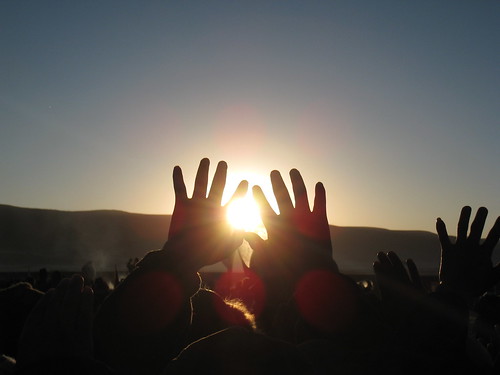
And so we found ourselves forgoing sleep to join a 1AM bus full of gringos heading out to the festival. We might have been half freezing (in spite of all the extra layers we’d brought and the dubious local rum we’d drunk while we waited for things to get going) but it was one of the best things of our trip so far. Joining the crowds on the site felt a bit like being at a weird South American version of Glastonbury, except with no music and where the only entertainment is the arrival of the sun…

Reaching out for the Sun's Energy...

I’ve no idea what happened to everyone else who had been on our bus, but we seemed once again to be mostly surrounded by locals (who explained what was going on, and told us that the thing to do was to put your hands in the air to soak up the sun’s energy). Oh, and then Evo Morales, the president of Bolivia, turned up in a helicopter to officiate at the ceremony. We couldn’t quite see what it was he was doing, but I did get to tick off the first item on my South American Presidential Bingo Spotting card (although having said that, it’s taken me so long to get round to writing this up, that he almost wasn’t president of Bolivia any more–he survived a referendum earlier this week–I don’t know whether that says more about how far behind I am in writing up this trip, or how quickly things can change in South America…)

*

When the ceremony ended we had to rush back to get to our bus, and so we joined a minor crush as everyone else tried to get out of the site down the same tiny flight of stairs that were woefully incapable of dealing with the volume of people who were there. While we waited to get out the locals around us laughed at me for being so tall and told me that I looked like that Doctor House off the TV show. Which is a new one for me…

*

Our journey back featured yet more moaning from the gringos on the bus. One of our fellow passengers described the two hour trip back to La Paz–in a comfortable half empty bus on mostly empty paved roads–as “the worst bus journey ever”.

Clearly the words of a man who hadn’t spent much time in Bolivia.

*

Oh yeah. The story of how I failed to get into prison isn’t actually as interesting as it sounds. We’d heard and read about La Paz’s famous San Pedro prison, where the guards turn a blind eye–if you slip them enough cash–to visitors coming in to meet a prisoner and see the city within a city inside, but we turned up without doing any proper research, expecting someone would just approach us like they do everywhere else, and it was only after this didn’t happen, and after I eventually plucked up the courage to ask the guards–in Spanish–if they’d let us in, that we realised that it wasn’t quite that easy.

I could come in, said the guard, if I knew who I wanted to visit. Oh. Right.

I opted not to try picking a name out of the air, and we left disappointed.

*

And that was mostly that for La Paz for us. We spent the rest of our time there hanging around with our friends, at least until I got my first bout of sickness of the trip so far, and had to spend two days in bed while an increasingly bored Sal went out to look at art galleries. And then it was time to head on to Oruro a little way down the country, where we were catching the train to the salt flats…

Categories
Bolivia South America

Bolivia

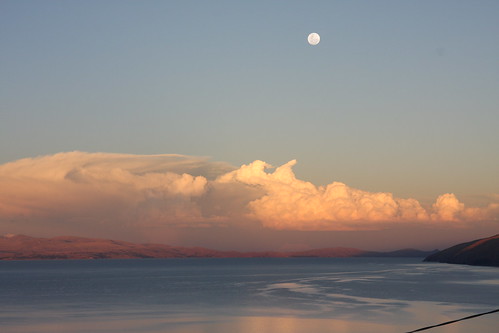
Sunset on the Isla del Sol

“No hay electricidad”, said the guy from the guesthouse as we made our way to our room. This we knew, as we’d just finished eating our delicious Lake Titicaca trucha criola by candlelight. We didn’t mind so much, as it sort of added to the charm of being one of just a handful of tourists spending the night on the quiet Isla del Sol, but I imagine it’s rather annoying if you live there (and it’s one thing eating Lake Titicaca trout by candlelight, but I’m not sure about having to cook Lake Titicaca trout by candlelight…)

If there was no electricidad, he went on to explain, there was also going to be no water. He pointed to the tank on the roof, the contents of which might otherwise have been pumped to our sink and toilet, and then to his wife, who was filling a large bucket that she was about to lug upstairs and deposit in our bathroom, demonstrating with a smaller bucket how we could use the contents as a makeshift toilet flush before bidding us goodnight…

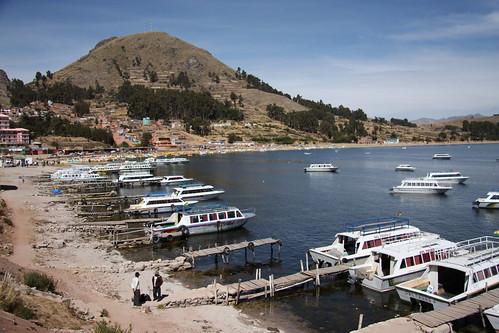
We’d come to the Island of the Sun after spending a couple of nights in the quiet border town of Copacabana, which is not at all like its Brazilian namesake. It’s a pleasant enough, laid-back little town, if a little touristy, where we relaxed and ate yet more trucha, went out on the lake in a pedalo (I did say it was touristy) and watched the world go by–including the “locals” who hang around the streets selling their craft work (they all look a bit like travellers who came into town but never left–I imagine you can probably tell how long they’ve been there by looking at the length of their dreadlocks, a bit like counting the rings on a tree). We also had a first in Copacabana–our hotel room had a telly. But it turned out to only get one channel, Bolivian state TV, and that seemed to show round the clock Che Guevara documentaries, so we weren’t exactly rushing home to watch it…

15th June 2008: Copacabana, Bolivia

To get to Copacabana, we’d taken an overnight bus from Cusco, and we were a bit anxious about this as we’d heard and read some horror stories about Bolivian buses in general, and the Litoral service we were catching in particular, but in the event it was fine, if a bit cold. In fact we were more annoyed by the other passengers than anything to do with the bus service, including the two guys on the seats opposite us who had decided to illuminate the otherwise entirely dark bus by looking at their entire selection of travelling photos on their iPod. Until Sal told them off.

On the flip side of being-kept-awake-by-bright-lights scenarios, when I woke up in the morning I peered through the curtains to see the most beautiful sunrise I’ve ever seen. We were travelling through a vast flat expanse, with the huge Lake Titicaca in the distance, and the sun slowly rising beyond that, the light reflecting back up off the lake and turning the whole sky a brilliant bright red. I could sort of see why this was the birthplace of the Incas’ sun worshipping mythology.

A little while later, the bus pulled to a stop at a fork in the road, and the 7 of us who were going to Copacabana, just over the border, rather than continuing on the fast road to the border crossing at Desaguadero, and then La Paz, were turfed off with our luggage and a lady from the bus company, and put onto a minibus for the 30 minute journey to the closer border crossing at Yunguyo. It turns out that our “directo” bus wasn’t quite so “directo” after all.

On the way, the lady from the bus company handed out Bolivian tourist cards for us to fill in, and we all started shakily scribbling in our details–the first of many times on this trip that I would make a barely readable scrawl on one of these things as our bus bumped along to a border. It’s just as well that no one ever really looks at them.

At the time I didn’t know that, though, and so I wondered if I mattered what I put for the question I didn’t understand: Días de permanencia? (helpfully translated into English as “days of permanency”). I asked the other gringos at the back of the bus if they knew what it meant. They weren’t sure, but they suggested it might depend on my visa.

“You do have your Bolivian visa, don’t you?” asked one of them, flicking through his passport to show me the sticker.

Oh. Really? My Bolivian visa? Oops. I was sure I’d checked this before we left, but surely they couldn’t have changed the rules? Could they?

Luckily it turned out that although they had changed the rules recently, the new requirements only apply to Americans. In the event, it was all fine. We were turfed off the minibus at the border and walked with our stuff to the Peruvian police check, where a disinterested Peruvian army chap stamped us out, and then across the street to the Bolivian side, where an equally nonplussed Bolivian army chap had stamped us in without even looking at the tourist card. And that was the start of country number 2–we piled back into a different minibus, which was then crammed to bursting with locals who were also making the 8km journey down into Copacabana, and we were on our way into town.