Categories
Peru South America

La Altituda

We made it out of Huacachina alive, though, surviving a tough hour’s slog up the sand dune directly behind our hotel to watch the sunset, as well as a bad lunch in a restaurant down the street that featured not only a fly in my coffee but also hairs on Sal’s straw and in my burger. Oh and the small matter of the taxi ride back to the bus station in the company of a driver who gleefully informed us half way there that he’d been drinking all day. It made for a scary final five minutes of the journey, although he didn’t seem to be significantly more dangerous than some of the sober drivers we’ve had so far…

After a night of knee crushing agony squeezed into my tiny seat (realising that being tall in South America isn’t necessarily a good thing) we arrived in Arequipa, Peru’s second city, and, at 2300 metres, our first baby steps towards altitude. Being a sensible type, Sal had already started taking Diamox, the anti-altitude sickness drug, but I’d foolishly chosen to hold off till Cusco. Perhaps it was indeed the altitude, or perhaps the after effects of the all night bus journey, but I found myself feeling decidedly woozy, and within a few hours had managed to spill an entire beer over myself at a bar overlooking the Plaza de Armas, and hit my head on a low bar on my way out of a restaurant so hard that it started bleeding. And of course, as we left said restaurant, with me still smelling of beer and clutching a small, thin Peruvian napkin to my head to stem the flow, we proceeded to bump into everyone we’d met so far on our travels, who all just happened to be walking down that exact street at that exact time…

Even then, I still didn’t start on the Diamox. Not until a few days later when we went off to the Colca Canyon (home to llamas, alpacas, the endangered Vicuñas, and many Condors). On the way there we reached a high point at over 4000 metres, and it really hit me, leaving me feeling sick and faint and having to have a sit down while Sal ran around with the camera taking photos.

Feeling the effects of the Altitude...

The pain was compounded shortly afterwards when we went for lunch with the rest of our tour group, a group that included an older Spanish couple who spoke no English, and a selection of other tourists who spoke English but no Spanish. This meant that responsibility for maintaining an awkward, stilted conversation fell to me as makeshift translator. All I really wanted to do was to go for a long lie down, but instead I was pushing the actually quite nice Alpaca steak around on the plate in front of me that the altitude sickness stopped me from wanting to eat while desperately trying to recall long forgotten verbs.

I started taking the Diamox straight away.

Luckily my translation duties for the day ended shortly afterwards when we left the Spaniards in their hotel and Sal and I went to nearby Yanque where we were staying. We almost had our hotel to ourselves. Apart from a couple of friendly Americans (the only other guests), the pet Alpaca, and the girl running the place, we were the only ones there. And after a short walk to the nearby natural hot springs, and back again over a rickety wooden bridge, we returned to the hotel for the coldest night of our lives. So far…

Baby Alpaca at our Hotel

Turns out those natty thermals I bought in the old people’s shop in Southport just before we left weren’t a waste of money after all.

And that was pretty much the end of Arequipa for us. After seeing the condors the next day we headed back to catch our night bus to Cusco…
Categories
Bolivia Peru South America

Just Fancy That…

Lonely Planet: South America on a Shoestring (10th Edition):

pp864 (Peru Chapter): “Lake Titicaca: South America’s largest lake is also the world’s highest navigable lake…”

pp205 (Bolivia Chapter): “Lake Titicaca is deservedly awash with gushing clichés. Although it is often wrongly described as the highest navigable lake in the world (both Peru and Chile have higher navigable bodies of water)…”

Still, it could be worse, the Venezuela chapter (which is not one of the destinations on our itinerary) was written by Thomas Kohnstamm

Categories
Peru South America

Sand

The problem with doing an amazing trip like this, is that you spend so long doing exciting things that you never have any time to write about them. And when you do, you’re so far behind that you can’t write about the exciting things you’ve just done, but only the ones that happened ages ago that you’ve almost forgotten about. For example, we’ve just come back from the Inca Trail, but if I started writing about that then I’d never get to tell you about the stuff we did two weeks ago. At least the photos are up to date (for now).

So where was I? Oh yeah, Ica…

*

Booking a bus ticket to Ica wasn’t without its problems. Cruz del Sur, the bus company we’d selected, have a moderately confusing website, which eventually claimed to have sold me some tickets (although only after rejecting my credit card twice, forcing me to register for “Verified By Visa”, and occasionally just changing the destination on my itinerary for no apparent reason). But we bought them in the end, and made our way to the terminal on Sunday morning feeling a bit average after a big and late Saturday night out in the bars of Barranco with some jovial Americans and assorted others from the hostel. We ribbed the Americans about having only 2 weeks’ vacation in which to see Peru, and they ribbed us about not having jobs. Yeah, I used to have one of those, I said. It was overrated…

The buses were surprisingly comfortable, although that may have had something to do with the fact that we’d picked the most expensive company–we’ll work our way down to the ones where you sit next to someone’s chickens eventually, but for now we’re sticking to the posh ones with reclining seats, meals, and DVDs. We did have to get the stewardess to turn down the volume on the tanoy, though, after an ear-splittingly loud announcement that seemed to go on forever. It was like the Spanish oral test from hell, but I stopped trying to understand after my ears started hurting, so let’s call that one a fail. (And after the oral, the DVDs they showed during the journey provided both a reading comprehension–also known as Training Day, in English with Spanish subtitles, which taught me some interesting swearwords–and then another listening test, in the form of some awful B-Movie called The Glass House, which we watched in dubbed Spanish with English subtitles.)

As well as showing bad movies, the posh buses also serve you food. Perhaps foolishly, I’d left the food choice set to Qualquiera (“Whatever”) when I bought the tickets, and that was a pretty accurate description of the random selection of meat and rice that turned up in front of us in a small tray. It was washed down with my first Inca Kola of the trip. It’s a ubiquitous South American soft drink that basically looks like radioactive piss in a bottle, and tastes as odd as that sounds, but I’m led to believe that if you travel in these parts for long enough you’ll grow to love it. We’ll see…

The journey to Ica took about 5 hours, through some interesting countryside. Sometimes desert, sometimes abandoned crumbling concrete buildings, the occasional apparently deserted shanty town and some post-quake rubble. The stop before Ica was Paracas, which appeared to have been particularly badly hit–when we reached Ica we shared a cab to Huacachina (just a few kms away) with a Canadian girl who’d been staying there and who told us that there was nothing left there, including no bank, which had meant that she hadn’t eaten for a day as she hadn’t been able to afford to get anywhere that did have a cash machine until her bus came…

Discussing this in the cab, the driver told us that he’d felt a tremor in Ica just a few hours ago…

The Lonely Planet describes Hospedaje El Huacachinero, which we’d decided to stay in, as “rickety”, “basic”, and “a work in progress”, but it was anything but. In fact it was more like a hotel than a hostel (and a little bit more expensive than The Point at S/.80 per night for the two of us–14 quid–rather than S/.64 we’d been paying in Lima), but, intrepid travellers that we are, even after just a few days on the road we were already wowed enough by the prospect of our own bathroom, with towels and everything, that we were prepared to pay the extra.

Sand Boarding, Huacachina

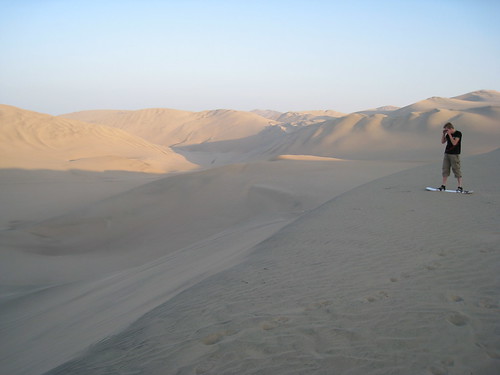
We’d come to Huacachina for the sand. It’s a little oasis of hostels and hotels in the middle of a desert of sand dunes. All the hotels have these big green dune buggies and they drive you up to the top of the dunes and back down again at laws-of-physics-defying angles. It’s a bit like being on a roller-coaster except driven by a laughing manic and with the very real possibility of death. Best of all, when you get to the top they chuck you out of the buggy and give you a small plank of wood with which to get yourself down again. You can either go down standing up, Snowboarding style, or if you’re not suitably skilled you can just lie down on your stomach and let gravity do the rest:

Sand Boarding, Huacachina

Fantastically good fun, although the sand does go everywhere.